

Burnout and clinical depression can look similar, but they’re not the same. In the discussion of burnout vs. depression, both can leave a person exhausted, unmotivated, and struggling to focus. The key difference? Burnout is linked to chronic workplace stress, while major depressive disorder is a mental health condition that can affect nearly every part of daily life. And yes, both can happen at once.
Understanding the difference matters because burnout may call for changes at work, while depression may need professional treatment. Neither should be brushed off as ordinary fatigue. Keep reading to learn how their symptoms, diagnosis, and treatment compare.
Key Takeaways
- Burnout typically develops in response to chronic workplace stress and involves exhaustion, cynicism, and reduced professional efficacy.
- Clinical depression affects mood, pleasure, thinking, physical functioning, and relationships, often beyond the workplace, with diagnostic criteria that include symptoms lasting at least two weeks.
- A mental health assessment can distinguish burnout from depression, identify overlapping conditions, and guide appropriate treatment, including workplace interventions, psychotherapy, medication, or selected neuromodulation therapies.
What Is Burnout?
Sunday night arrives, and the thought of going to work the next morning already feels exhausting. Emails seem endless. Small requests feel like too much. For some people, this is what burnout begins to look like.
The World Health Organization (WHO) links burnout to chronic workplace stress that has not been managed successfully. Under the International Classification of Diseases, 11th Revision (ICD-11), it is classified as an occupational phenomenon. WHO does not consider burnout a medical condition.
“Burn-out is a syndrome conceptualized as resulting from chronic workplace stress that has not been successfully managed.” – World Health Organization (WHO)
There are three main signs to look for.
- Exhaustion: Getting through the day takes more effort than usual. A person may feel drained before work even begins, then struggle to recover once the day is over.
- Cynicism: Work starts to feel meaningless or irritating. Someone who used to care about their job may become distant from colleagues or stop feeling invested in their responsibilities.
- Lower performance: Concentration becomes harder to maintain. Tasks take longer, details get missed, and confidence in the quality of work may slip.
The changes can be frustrating, especially when a person remembers how easily they handled the same responsibilities before.
But burnout does not always follow someone into every part of life. An employee might dread the workday and still enjoy a long walk, a favorite meal, or an evening with friends. That difference can be a useful clue, though it is not proof of a diagnosis.
Burnout can affect sleep and relationships, and it may occur alongside anxiety or depression. If the exhaustion keeps returning, something beyond a few days of rest may be needed.
What Is Clinical Depression?

Depression can make ordinary life feel unfamiliar. Getting dressed may take effort. A favorite hobby may no longer feel enjoyable. Even answering a message from someone close can seem like a task that can wait until tomorrow.
Major depressive disorder (MDD) is a diagnosable mental health condition. It affects mood, thinking, and daily functioning, and it does not have to begin with a stressful job or a difficult workplace.
Under the Diagnostic and Statistical Manual of Mental Disorders, Fifth Edition, Text Revision (DSM-5-TR), a major depressive episode generally involves at least five symptoms during the same two-week period. One must be in a depressed mood or a loss of interest or pleasure. The symptoms must also cause significant distress or interfere with daily life.
Possible symptoms include:
- Low mood: Feeling sad, empty, or hopeless for much of the day.
- Loss of interest: Activities that once brought enjoyment no longer feel worth the effort.
- Sleep changes: Trouble falling asleep, waking early, or sleeping much longer than usual.
- Appetite changes: Eating less or more than before, sometimes with an unplanned change in weight.
- Fatigue: Feeling exhausted after ordinary activities, even when there is no clear reason for the tiredness.
- Concentration difficulties: Losing track while reading, struggling to make decisions, or finding it hard to follow a conversation.
- Guilt or worthlessness: Blaming oneself excessively or feeling that other people would be better off without them.
- Changes in movement: Noticeably slower speech or movement, or unusual restlessness.
- Thoughts of death or suicide: Repeated thoughts about dying or suicidal thoughts.
“Major depression includes symptoms of depressed mood or loss of interest, most of the time for at least 2 weeks, that interfere with daily activities.” – National Institute of Mental Health (NIMH)
Depression does not always look like constant sadness. Some people keep going to work and appear fine to others, while privately feeling numb or disconnected. Others notice changes in sleep and energy before they recognize a change in mood.
There is no need to wait two weeks to ask for help. That period is part of the diagnostic criteria, not a rule for delaying care. Severe symptoms or suicidal thoughts need prompt attention. A clinician may also check for physical health conditions, medication effects, or sleep problems that could contribute to the symptoms.
Burnout vs. Depression: Key Differences

When comparing depression vs. burnout, one question is worth asking: what happens when work is no longer part of the day?
Someone with burnout may feel some relief after leaving the office or taking time off. With depression, low mood or a loss of interest may remain even when work demands are out of the picture. There are exceptions, though, and neither pattern can confirm a diagnosis.
| Feature | Burnout | Clinical Depression |
| Where it shows up | Often strongest around work | May affect work, home, and relationships |
| Mood outside work | May improve away from work | Low mood may continue during time off |
| Effect of time off | Rest may help, especially with workplace changes | Symptoms may remain despite rest |
| Interest in hobbies | Enjoyment may remain outside work | Pleasure may decline across many activities |
| Diagnosis | WHO occupational phenomenon, not a medical condition | Diagnosable mental health condition |
The World Health Organization’s guidance on burnout explains its connection to the workplace. The National Institute of Mental Health outlines the symptoms and treatment options for depression.
When symptoms affect several areas of life, a structured approach to mental health treatment can help people explore the support available for depression, burnout, and related conditions.
Consider someone who spends Saturday gardening and feels more like themselves again. Work may be a major part of the problem. Now consider someone who no longer wants to garden, avoids friends, and feels hopeless even during a holiday. That broader change deserves attention.
Real experiences are rarely this clear-cut. Burnout can affect life at home, and a person with depression can still have good moments. The length of time symptoms last, how severe they become, and how much they disrupt daily life all matter.
Signs Burnout Has Become Clinical
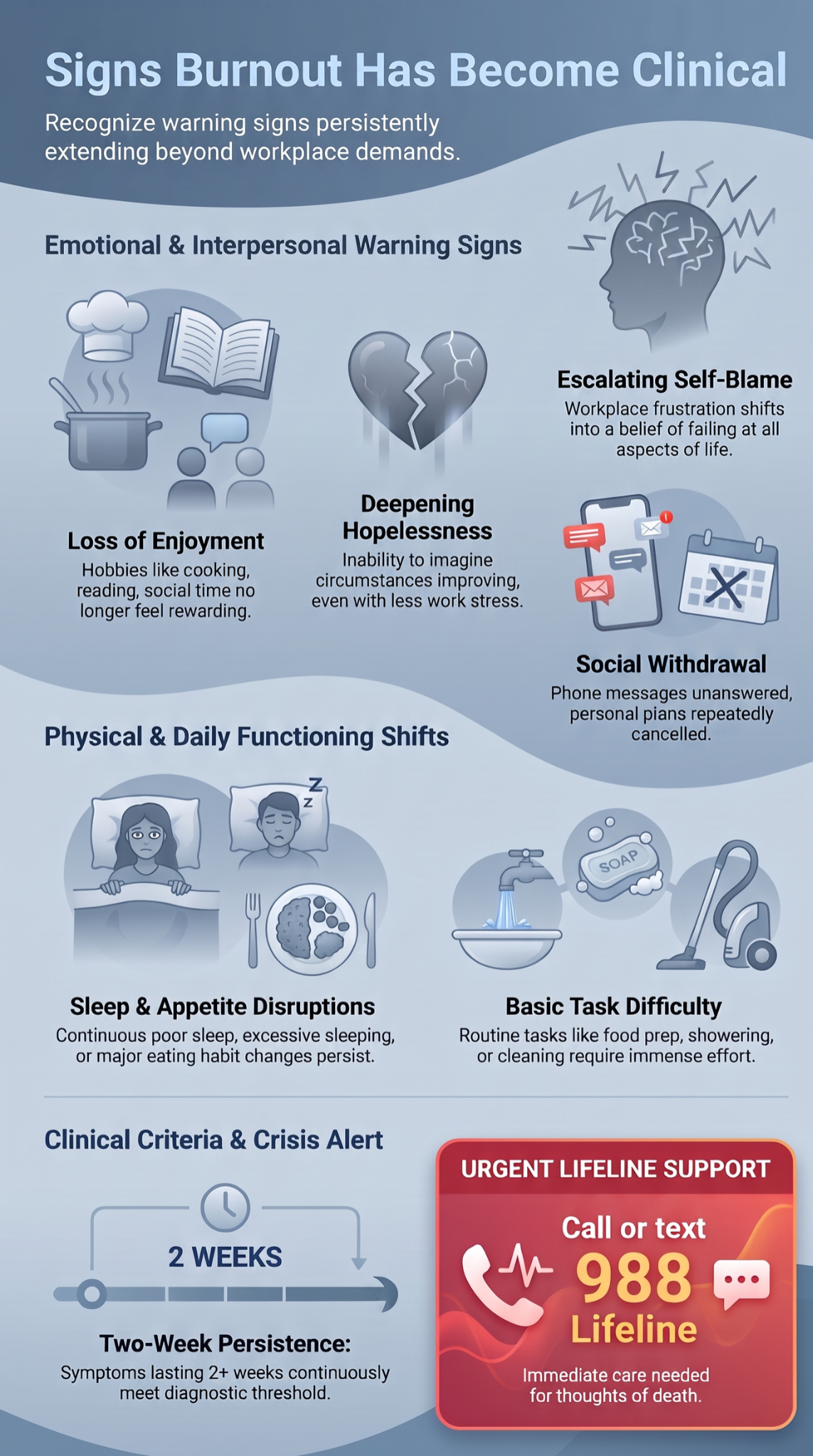
Burnout does not automatically become depression. The two can overlap, however, and prolonged stress may contribute to worsening mental health.
Sometimes the change is easy to miss. A person may blame work for feeling tired, then blame poor sleep when the tiredness continues. Later, even activities that once helped them unwind begin to feel like a chore.
Signs that deserve closer attention include:
- Enjoyment fades: Seeing friends, cooking, reading, or spending time with family no longer feels rewarding.
- Hopelessness sets in: The person cannot picture things improving, even when work becomes less demanding.
- Self-blame grows: Feeling unsuccessful at work turns into believing they are failing at everything.
- Sleep or appetite changes persist: The person continues sleeping poorly, sleeping excessively, or eating much less or more than usual.
- Basic tasks become difficult: Preparing food, showering, or keeping the home in order takes more effort than before.
- People are pushed away: Messages go unanswered, plans are canceled, and contact with loved ones becomes less frequent.
- Thoughts of death or suicide appear: These require prompt attention, even if work stress seems to be the original cause.
Symptoms lasting two weeks or longer may meet the duration requirement for a major depressive episode, but a clinician must assess the other diagnostic criteria as well.
There is no single moment when burnout officially turns into depression. When symptoms persist or begin to interfere with daily life, outpatient mental health treatment programs may provide structured support based on a person’s needs.
In the United States, people experiencing emotional distress or suicidal thoughts can call or text the 988 Suicide & Crisis Lifeline. Anyone in immediate danger should contact local emergency services or go to the nearest emergency department.
Getting the Right Help

Not every exhausted person needs the same treatment. Someone dealing with an unreasonable workload may need changes at work. Someone who has lost interest in nearly everything may need a mental health assessment. Sometimes both types of support are necessary.
A clinician may ask when the symptoms began, how sleep has changed, and whether the person can still manage work, relationships, and daily tasks. A tool such as the Patient Health Questionnaire 9 (PHQ 9) can help screen for depression. It does not provide a diagnosis by itself.
Help for Burnout
Taking a break can help. But returning to the same workload, the same pressure, and the same lack of support may bring the exhaustion straight back.
Depending on the circumstances, support may include:
- Reviewing work responsibilities: Discussing priorities, deadlines, and workload with a manager may help make the job more manageable. Not every workplace can offer immediate changes, but identifying the main pressure points is a start.
- Protecting personal time: Regular breaks, enough sleep, and fewer work messages outside working hours can create more room to recover.
- Speaking with a therapist: Cognitive behavioral therapy (CBT) may help people work through perfectionism, harsh self-criticism, or difficulty setting boundaries.
- Trying resilience coaching: Resilience coaching can help someone practice coping skills, manage stress, and set realistic goals. It should not replace clinical care when depression or another mental health condition is suspected.
- Reaching out to trusted people: Talking with a friend, relative, or supportive colleague may make it easier to recognize what needs to change.
Recovery is not always quick. Some people feel better when work conditions improve. Others continue to struggle and need an assessment for depression, anxiety, sleep disorders, or other health concerns.
Treatment for Depression
When depression is suspected, a clinician can discuss treatment based on the person’s symptoms, medical history, and previous experiences with care. There is no need to assume that one treatment will suit everyone. A comprehensive range of mental health therapies and services may help clinicians develop a care plan that reflects each person’s needs and treatment goals.
Options include:
- Psychotherapy: CBT helps people examine patterns of thinking and behaviour that may worsen depression. Interpersonal therapy focuses on relationships, grief, communication, and difficult life changes.
- Medication: Antidepressants, including selective serotonin reuptake inhibitors (SSRIs), may help relieve symptoms. A qualified prescriber can explain possible benefits and side effects.
- FDA-cleared transcranial magnetic stimulation (TMS): TMS uses magnetic pulses to stimulate targeted brain circuits. It may be considered for eligible people whose depression has not improved enough with medication. Suitability depends on clinical history and the specific device’s clearance.
- Follow-up care: Regular appointments help clinicians check progress, discuss side effects, and adjust treatment if needed.
TMS is noninvasive. It requires no surgery or anesthesia, and patients stay awake during sessions. A magnetic coil rests against the scalp and delivers pulses to targeted brain areas. It can be an option for certain patients with depression, but it is not a treatment for occupational burnout itself.
Anyone taking antidepressants should speak with their prescriber before stopping medication or changing the dose. If symptoms worsen or suicidal thoughts develop, prompt clinical review is important.
Start With a Mental Health Assessment
Feeling exhausted, low, or unmotivated for a prolonged period can disrupt your personal and professional life, especially when you are unsure whether burnout or depression is the root cause. You do not have to navigate this alone. A comprehensive mental health assessment can clarify your symptoms and help determine the right level of care.
At Compass Integrative Recovery, our structured outpatient programs, including our Intensive Outpatient Program (IOP) and Partial Hospitalization Program (PHP), provide evidence-based support tailored to your unique challenges. Whether you need intensive stabilization or flexible care to reclaim your daily balance, our clinical team is here to guide your recovery.
FAQs
Can burnout turn into depression?
Burnout and depression can coexist, and prolonged occupational stress may contribute to worsening depressive symptoms in some people. However, burnout does not inevitably develop into major depressive disorder. A clinical assessment can determine whether a person meets depression criteria and whether additional treatment is needed.
Does burnout go away with time off?
Time off can help when exhaustion is closely related to excessive work demands, especially when leave allows adequate sleep and recovery. However, a vacation alone may not resolve burnout if the same workplace conditions return. Persistent low mood or loss of pleasure across different areas of life warrants assessment for depression and other conditions.
Is burnout a medical diagnosis?
No. The World Health Organization classifies burnout as an occupational phenomenon in ICD-11, not a medical condition. Major depressive disorder, by contrast, is a diagnosable mental health condition. Burnout symptoms can still be serious and may require professional support.
When should I see a professional for burnout?
Professional assessment is appropriate when exhaustion, cynicism, low motivation, or reduced functioning persists for weeks, affects relationships or daily responsibilities, or fails to improve after meaningful rest and workload changes. Severe hopelessness, inability to care for oneself, or suicidal thoughts require urgent evaluation.