

A high-functioning alcoholic is an individual who experiences alcohol use disorder (AUD) while continuing to manage work, family, and daily responsibilities. They may lead companies, manage teams, or excel in high-level careers while concealing their drinking habits. However, professional success does not prevent alcohol from taking a severe toll on their physical health, emotional well-being, and personal relationships.
The signs can be subtle and easily overlooked, even by the individual themselves. Understanding what to look for, recognizing when to seek help, and engaging with qualified medical professionals or addiction specialists are critical first steps toward sustainable recovery.
Key Takeaways
- Professional Success Can Hide Alcohol Use Disorder
- Early Recognition Expands Treatment Options
- Alcohol Withdrawal Requires Medical Guidance
What Is a High-Functioning Alcoholic?
A high-functioning alcoholic refers to an individual who maintains personal, family, and professional responsibilities while silently struggling with alcohol use disorder (AUD). Because they often hold demanding jobs, maintain stable routines, and meet external expectations, their dependence easily goes unnoticed. However, outward success does not prevent the progressive physical, psychological, and relational toll caused by chronic alcohol use.
Why Are Executives at Higher Risk?
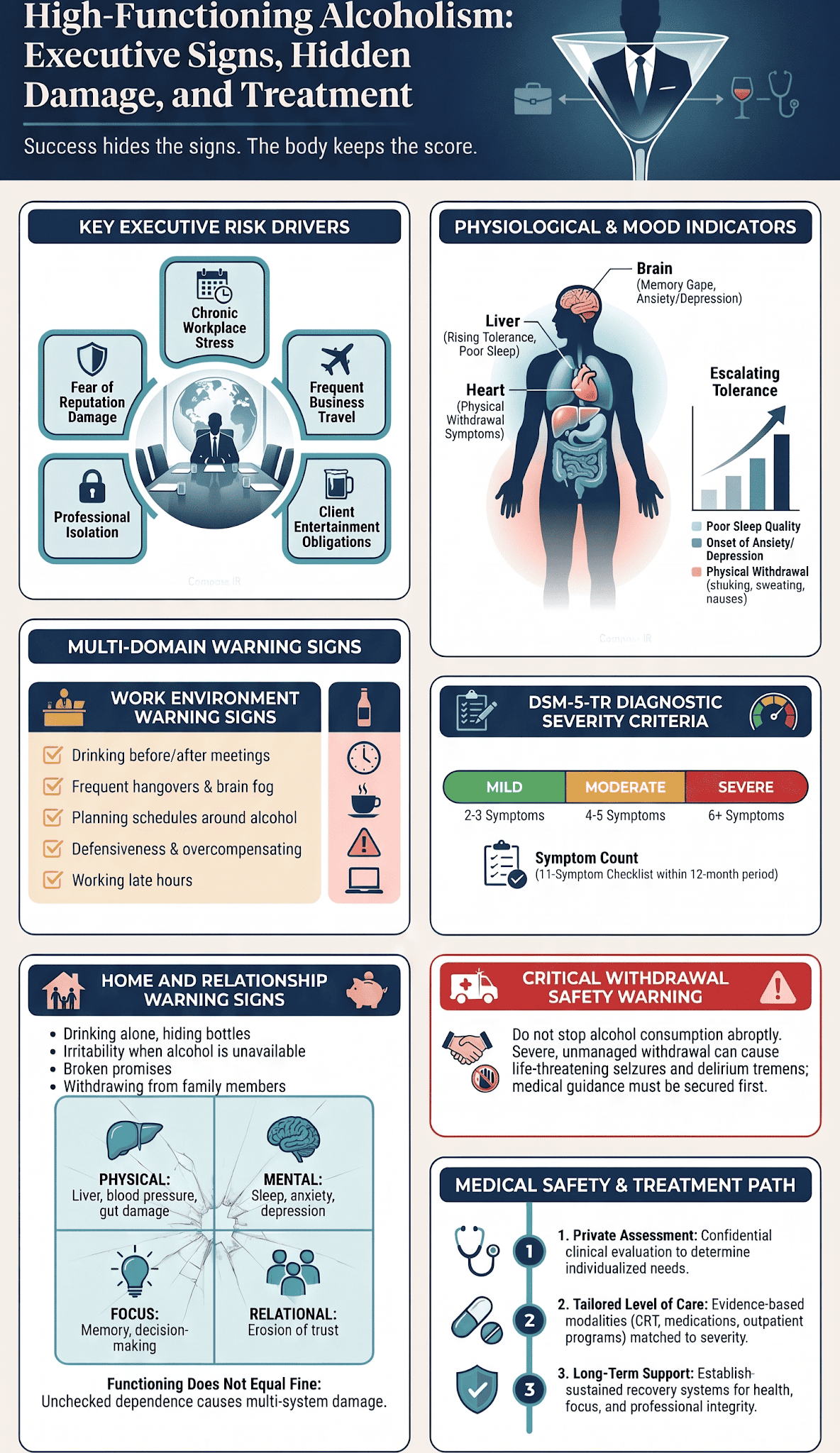
For executives and corporate leaders, professional environments often normalize heavy drinking while masking the early signs of alcohol use disorder. High-stakes expectations, executive travel, and corporate entertaining create a culture where alcohol is frequently present and easily concealed. While career pressure alone does not cause AUD, specific workplace dynamics significantly elevate the risk:
- Stress: Alcohol becomes the default coping tool for tight deadlines, performance scrutiny, and high-pressure decision-making.
- Client dinners: Frequent business dinners and networking events make heavy, regular alcohol consumption seem normal and socially acceptable.
- Travel: Solitary hotel stays, airport lounges, and extended time away from home routines create unmonitored opportunities to drink heavily.
- Isolation: Senior leaders often have few trusted internal peers with whom they can openly share personal struggles.
- Fear of how it looks: Deep concern over professional reputation, executive standing, and career trajectory prevents individuals from acknowledging the problem or seeking help.
These dynamics persist even when work performance remains high. A clinical diagnosis of AUD is based on physiological patterns and behavioral impairment, regardless of job title or income.
Signs of a High-Functioning Alcoholic
Someone experiencing alcohol use disorder may continue meeting work and family responsibilities while showing warning signs in drinking habits, mood, or attempts to conceal alcohol use. These signs may become apparent before major problems develop at work or home.
A person may still meet deadlines and handle chores at home, while spending more and more time drinking or recovering from it. High tolerance can hide the problem. The person may seem less drunk than you would expect after drinking.
A formal clinical assessment is far more reliable than outward appearances when evaluating potential AUD. Under the Diagnostic and Statistical Manual of Mental Disorders (DSM-5-TR), AUD is diagnosed when an individual meets at least two of eleven established criteria within a 12-month period: two to three criteria indicate mild AUD, four to five indicate moderate AUD, and six or more indicate severe AUD. A qualified clinician must evaluate these symptoms to establish a formal diagnosis. Learning to recognize the signs of alcohol addiction can help individuals identify concerning drinking patterns, even when professional and personal obligations continue to be met.
The signs below can point to a problem that needs a professional evaluation. No single behavior proves a diagnosis.
At Work
Warning signs at work often build slowly. Some people continue performing well at work while overcompensating for the effects of drinking, such as fatigue or difficulty concentrating.
- Drinking before or after meetings to manage stress or anxiety.
- Experiencing hangovers, disrupted sleep, or difficulty concentrating at work.
- Scheduling work around opportunities to drink or recover from drinking.
- Repeatedly promising to cut back but struggling to follow through.
- Reacting defensively when others express concern about drinking.
- Using alcohol to cope with work-related anxiety, frustration, or disappointment.
An individual does not need to miss deadlines or perform poorly for drinking to be problematic. Similarly, experiencing workplace stress alone does not indicate AUD. A trained clinician considers overall drinking patterns, symptom severity, personal and professional disruption, and the ability to control consumption.
At Home
Family members may notice changes that coworkers do not, particularly when drinking affects relationships, household responsibilities, or behavior at home.
- Drinking alone or hiding bottles and receipts.
- Becoming irritable or anxious when alcohol is not available.
- Promising a partner to cut back, but not keeping that promise.
- Missing family events because of drinking or hangovers.
- Pulling away from children and partners.
- Spending more and more household money on alcohol.
Loved ones may hesitate to speak up when an individual continues to provide financially and maintains a strong professional reputation. However, fulfilling financial or executive responsibilities does not mean alcohol is not causing harm at home.
Constructive conversations should focus on specific observable behaviors rather than judgment. For example, a partner might mention noticing frequent late-night drinking, disrupted sleep, or missed family commitments. Using labels like “alcoholic” often prompts defensiveness rather than open dialogue.
In Health and Mood
Physical and mood changes can provide key insights into an underlying issue, though no single symptom confirms a diagnosis on its own. When problematic drinking occurs alongside anxiety, depression, or chronic stress, mental health treatment for co-occurring conditions offers a comprehensive approach to address overlapping concerns within a coordinated care plan.
- Needing more alcohol to feel the same effect.
- Having anxiety, sweating, nausea, or shaky hands when the alcohol wears off.
- Having ongoing sleep problems or feeling tired during the day.
- Feeling more anxious or more depressed over time.
- Having memory gaps after drinking.
- Continuing to drink even after a doctor’s warning or repeated health problems.
Tolerance and physical withdrawal require special attention, as both indicate physiological adaptation to alcohol.
As highlighted by the Mayo Clinic:
“Developing a tolerance to alcohol so you need more to feel its effect and experiencing withdrawal symptoms, such as nausea, sweating and shaking, when you don’t drink, or drinking to avoid these symptoms.” — Mayo Clinic
Alcohol withdrawal can cause tremors, sweating, acute anxiety, insomnia, and nausea. Severe cases can lead to seizures or delirium tremens—a life-threatening medical emergency characterized by severe confusion, agitation, and cardiovascular distress.
These physical symptoms require prompt medical evaluation and should never be viewed as a lack of willpower or poor stress management.
Why Functioning Isn’t the Same as Fine

Fulfilling daily responsibilities and maintaining a steady career can create a false sense of security. However, managing external duties does not shield the body and mind from the progressive consequences of alcohol use disorder. Over time, persistent heavy consumption impacts several critical areas:
- Physical health risks: Sustained heavy drinking damages vital organ systems, substantially raising the risk of liver disease, hypertension, cardiovascular strain, and digestive disorders.
- Mental health toll: Chronic alcohol use disrupts neurochemical balance, fragmenting restorative sleep and aggravating underlying anxiety and depression.
- Cognitive deficits: Cumulative sleep debt and mild withdrawal diminish executive function, decision-making capabilities, and mental stamina during work hours.
- Interpersonal strain: Emotional withdrawal, secrecy around drinking, and unreliability gradually erode foundational trust with spouses, children, and close colleagues.
An individual does not need to hit rock bottom or lose their job before seeking clinical guidance. Early assessment prevents long-term health complications and preserves flexible outpatient treatment options.
Treatment That Fits a Demanding Career
Treatment options can often be adapted to fit demanding professional schedules. Care models may include medical evaluations, outpatient therapy, targeted medications, and ongoing clinical follow-ups. Depending on individual clinical requirements, outpatient addiction treatment services can provide structured, continuous support without requiring full residential admission. The appropriate level of care depends on the severity of AUD, withdrawal risk, medical history, and existing home support structures.
Many professionals participate in outpatient programs while maintaining work commitments. Others may benefit from residential care, a short medical leave, or medically supervised withdrawal management. However, work demands should never compromise personal safety; if severe withdrawal symptoms or medical complications arise, health and safety must remain the top priority.
| Treatment option | Purpose | When it may be appropriate |
| Medical Assessment | Evaluates drinking patterns, withdrawal risks, and overall health | As an initial step to determine appropriate care. |
| Individual Counseling or Cognitive Behavioral Therapy | Helps address triggers, stress, and drinking-related habits | When psychological support can help change drinking behaviors. |
| Outpatient Treatment | Provides structured care while allowing the person to return home | When the person’s medical needs and withdrawal risk make outpatient care suitable. |
| Medication | May help reduce cravings or support recovery | When a clinician determines that medication is appropriate. |
| Medically Supervised Withdrawal Management | Monitors and manages withdrawal symptoms | When physical dependence or the risk of severe withdrawal requires medical supervision. |
- An individualized AUD treatment plan typically progresses through three core stages:
- Confidential assessment. A physician or addiction specialist reviews drinking frequency and volume, withdrawal history, current medications, and overall medical and psychiatric health. Diagnostic testing, such as blood work or liver function panels, may also be conducted. This step clarifies whether outpatient care is safe or if medically supervised detoxification is required first.
- Tailored level of care. Care plans are customized to meet specific clinical needs, incorporating individual psychotherapy, cognitive behavioral therapy (CBT), support groups, outpatient programming, and FDA-approved medications (such as naltrexone, acamprosate, or disulfiram). Treatment targets triggers, cravings, co-occurring mental health conditions, and physical health. Individuals at risk for severe withdrawal start in a medical stabilization setting before transitioning to outpatient care.
Research from the National Institute on Alcohol Abuse and Alcoholism (NIAAA) emphasizes:
“Alcohol withdrawal can be life threatening if patients who chronically engage in heavy drinking stop drinking suddenly, rather than cutting back gradually or stopping drinking with medical support.” — National Institute on Alcohol Abuse and Alcoholism (NIAAA) - Long-term aftercare. Sustainable recovery involves ongoing therapy, clinical check-ins, relapse-prevention strategies, and lifestyle adjustments. These structures help individuals navigate triggers, manage cravings, and sustain progress while balancing career and family responsibilities.
Get Confidential Help
Seeking support for alcohol use disorder can feel daunting when privacy and career standing are top concerns. Taking action to protect your health and consulting medical professionals is a proactive, responsible choice.
If you have concerns about your drinking, consult a qualified healthcare provider or addiction specialist to discuss evaluation and care options. Contact Compass IR to explore connection with appropriate care providers or clinical referral networks. Before starting treatment, inquire about specific AUD programs, clinician credentials, withdrawal management protocols, available care modalities, and privacy safeguards.
FAQs
Can a high-functioning alcoholic stop drinking on their own?
Stopping abruptly without clinical supervision can be dangerous for anyone with physical alcohol dependence. Sudden cessation from chronic heavy drinking carries severe withdrawal risks, including tremors, seizures, and delirium tremens. A qualified physician or addiction specialist should evaluate physical dependence first to determine whether outpatient therapy, targeted medications, or medically managed withdrawal is necessary to stop safely.
How much does a high-functioning alcoholic usually drink?
There is no set drink count that defines a high-functioning alcoholic, as the phrase is descriptive rather than a formal clinical diagnosis. Clinicians diagnose alcohol use disorder (AUD) using DSM-5-TR criteria, evaluating patterns of impaired control, strong cravings, tolerance, and physical consequences over a 12-month period, rather than outward vocational success or daily volume alone.
Is addiction treatment confidential for executives?
Yes. In the United States, substance use disorder treatment records receive strict federal protection under HIPAA and 42 CFR Part 2 regulations. These stringent privacy laws ensure that your clinical records, attendance, and medical details cannot be shared with employers, insurance carriers, or colleagues without your explicit, written consent, barring very narrow emergency exceptions.
Can I keep working while in treatment?
Many individuals continue working while attending outpatient addiction treatment. Flexible options, such as Intensive Outpatient Programs (IOP), provide structured therapy and medical consultations outside standard business hours. However, if severe withdrawal risks or medical stabilization require immediate attention, a clinician may recommend brief medical leave before you resume work during care.